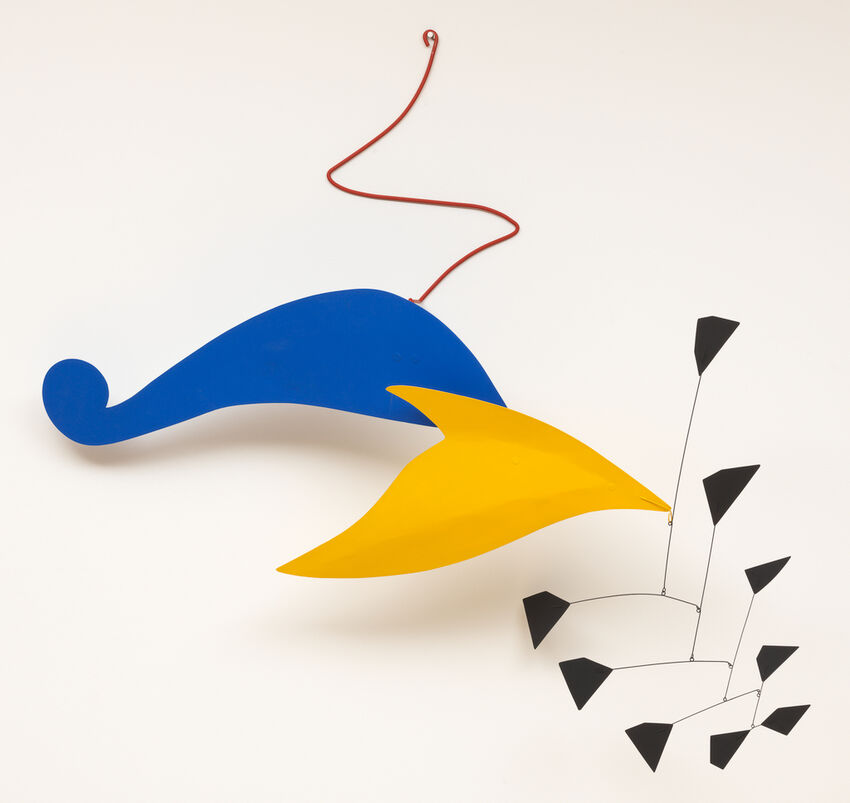
Artwork Info
- Artwork title
- Fishy
- Artist name
-
Alexander Calder
- Date created
- 1962
- Classification
- sculpture
- Medium
- metal and paint
- Dimensions
- 59 × 62 3/4 × 30 in. (149.9 × 159.5 × 76.2 cm)
- Credit
- The Doris and Donald Fisher Collection at the San Francisco Museum of Modern Art
- Copyright
- © Calder Foundation, New York / Artists Rights Society (ARS), New York
- Permanent URL
- https://www.sfmoma.org/artwork/FC.330.A-D
- Artwork status
- On view on Floor 5 as part of Calder, Kelly, LeWitt: Fundamentals of Form
On view on Floor 5 as part of Calder, Kelly, LeWitt: Fundamentals of Form
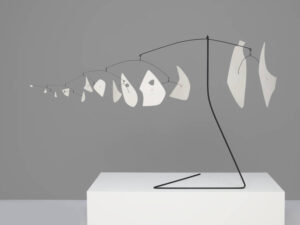
The bright primary colors used in this wall-mounted mobile gesture to the artist’s formative 1930 visit to Piet Mondrian’s Paris studio, shortly before Calder shifted from figuration to abstraction. Fishy does not depict a fish but rather suggests a fish’s form and fluid movements: a wavy red wire pushes two flat, flowing metal panels off the wall and into the viewer’s space, while the spine of black metal elements suspended from a yellow shape is free to wiggle and sway in the air. Beginning with mechanical moving sculptures such as Aquarium (1929), the themes of fish and the sea periodically resurfaced throughout Calder’s work. As he described in 1943, “A mobile in motion leaves an invisible wake behind it, or rather, each element leaves an individual wake behind its individual self. . . . In their handling, i.e., setting them in motion. . . . A slow gentle impulse, as though one were moving a barge is almost infallible.” While anchored to the wall, this abstract work is inflected with a capacity for subtle, sinuous motion.
Please note that artwork locations are subject to change, and not all works are on view at all times.
Only a portion of SFMOMA's collection is currently online, and the information presented here is subject to revision. Please contact us at collections@sfmoma.org to verify collection holdings and artwork information. If you are interested in receiving a high resolution image of an artwork for educational, scholarly, or publication purposes, please contact us at copyright@sfmoma.org.
This resource is for educational use and its contents may not be reproduced without permission. Please review our Terms of Use for more information.